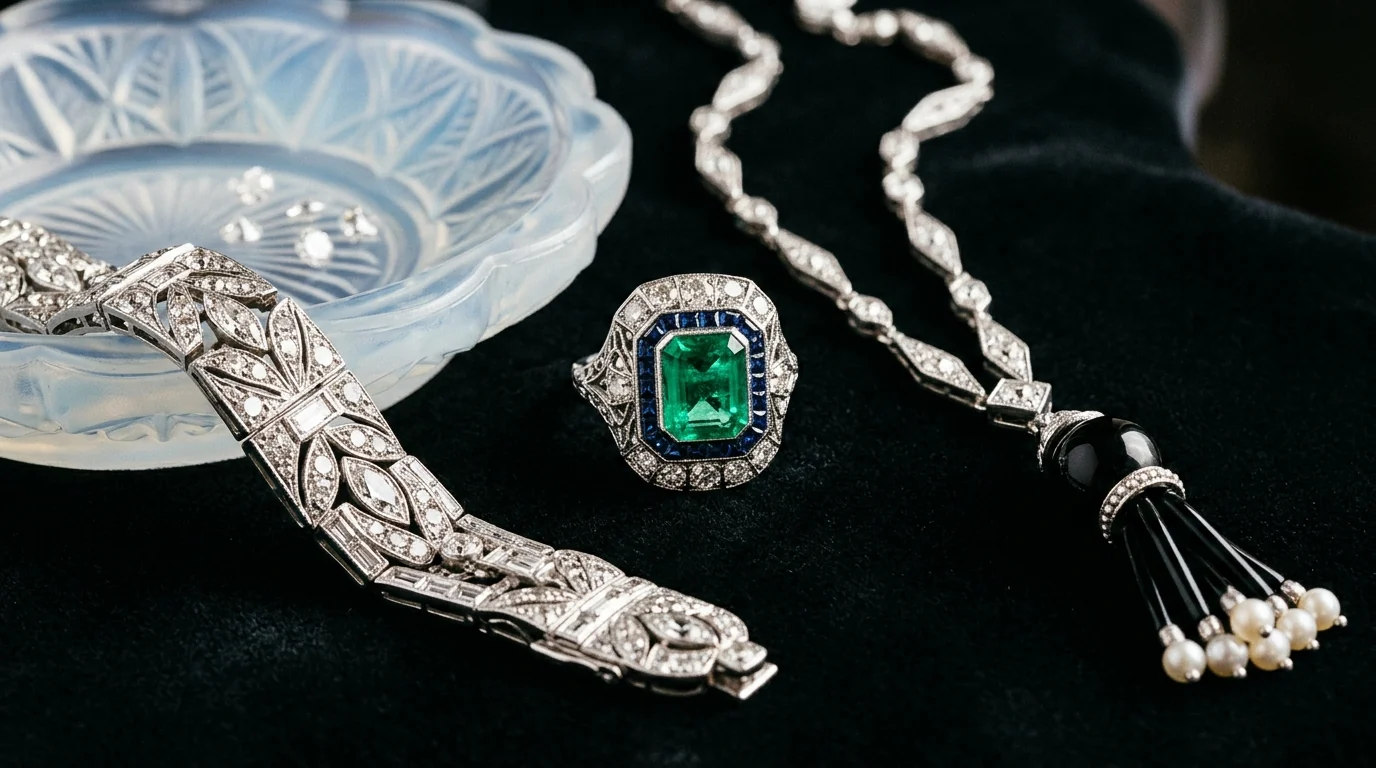

Art deco jewelry emerged between 1919 and 1939—taking its name from the landmark 1925 Paris Exposition Internationale des Arts Décoratifs et Industriels Modernes—replacing soft Edwardian floral garlands with bold architectural geometry, platinum milgrain work, step-cut diamonds, and high-contrast onyx, emerald, sapphire, and coral accents. Designed for sleeveless Jazz Age silhouettes, these pieces remain among the most collectible fine jewelry forms in the world.
Key Takeaways
- Signature Metal: Strong, hypoallergenic 900–950 platinum (later joined by 18k white gold) enabled razor-thin bezel settings, pierced filigree, and microscopic milgrain beading.
- Precision Gem Cuts: Asscher, emerald, baguette, trapeze, half-moon, and French calibré-cut gemstones created seamless mosaic light planes without visible prongs.
- High-Contrast Palettes: Rock crystal, black onyx, Colombian emerald, Kashmir sapphire, jadeite, and red coral replaced Victorian monochrome gold.
- Iconic Silhouettes: Tassel sautoir necklaces, twin-stone toi et moi rings, convertible double-clip brooches, and stacked diamond line bracelets defined Roaring Twenties glamour.
Table of Contents
1. How Modernism and the 1925 Paris Exposition Reshaped Fine Jewelry
Before World War I, Belle Époque jewelers favored delicate ribbon bows and naturalistic lily-of-the-valley motifs. Postwar emancipation, Cubist painting, Bauhaus architecture, and the 1922 opening of Tutankhamun’s tomb triggered a radical aesthetic pivot toward streamlined symmetry and ancient Egyptian, Persian, and East Asian color blocks.
Couture revolutions accelerated the shift. Just as Paul Poiret liberated women from rigid Edwardian corsetry, tubular drop-waist evening dresses exposed bare arms, collarbones, and bobbed necks that demanded elongated vertical pendulums and wrist-to-elbow cuffs.
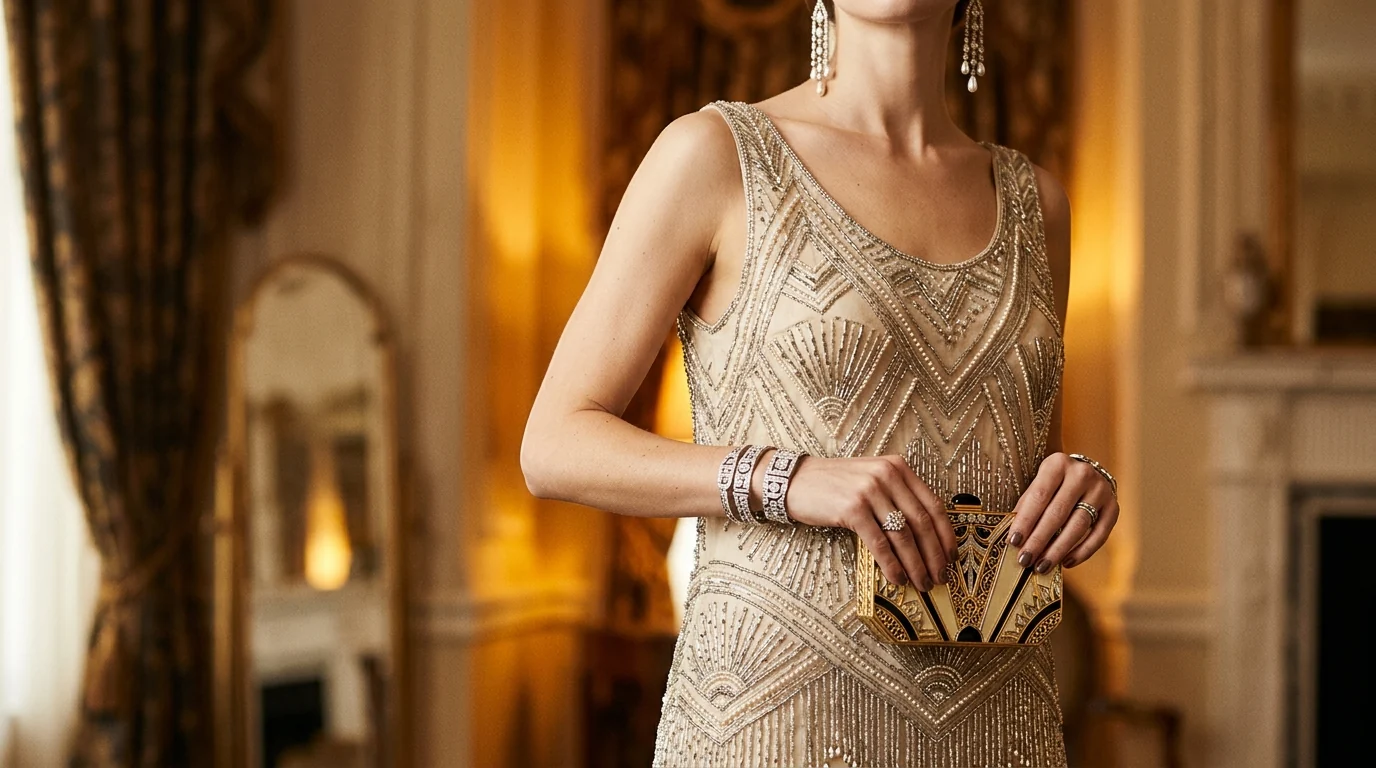
Under electric ballroom chandeliers, Parisian maisons—Cartier, Van Cleef & Arpels, Boucheron, Chaumet, and Mauboussin—matched the kinetic shimmer of 1920s beaded and sequin flapper dresses with articulated platinum links engineered to ripple with every Charleston step.
2. Seven Signature Gem Cuts That Define Art Deco Jewelry
Lapidary breakthroughs in Antwerp and Paris allowed cutters to facet colored stones and diamonds like architectural glass blocks. According to gemological archives at the Gemological Institute of America (GIA), authentic art deco jewelry relies on crisp step-cut and custom-fitted facets rather than modern round brilliant cuts alone.
| Gem Cut | Geometric Profile | Optical Effect | Classic Art Deco Jewelry Placement |
|---|---|---|---|
| Asscher Cut | Octagonal square with cropped corners & deep pavilion | “Hall of mirrors” concentric flashes | Solitaire engagement rings & bracelet centerpieces |
| Emerald Cut | Rectangular step-cut with parallel linear facets | Broad, icy mirror-like light ribbons | Statement cocktail rings & pendant drops |
| Baguette Cut | Narrow elongated rectangle (tapered or straight) | Clean architectural framing lines | Ring shoulders, watch bezels & geometric borders |
| Old European Cut | Round outline, high crown, small table, open culet | Warm, romantic candlelit fire | Pavé filigree plaques & cluster halos |
| Calibré Cut | Custom-cut miniature squares, arcs & trapezoids | Unbroken channel-set ribbon of saturated color | Sapphire, ruby, emerald & onyx halo outlines |
| Trapeze & Bullet Cuts | Tapered trapezoid or pointed five-sided prism | Directional stepped sunburst transition | Stepped skyscraper ring flanks & double clips |
| Carved Tutti Frutti | Fluted cabochon & leaf-carved ruby, emerald, sapphire | Lush three-dimensional Mughal relief | Cartier bandeau headpieces & wide cuff bracelets |
3. Platinum Metallurgy, Pierced Filigree, and Milgrain Craftsmanship
Oxyacetylene torches capable of reaching 1,770°C unlocked high-purity platinum work in the early twentieth century. Unlike silver—which tarnished black against skin and evening silk—or yellow gold, platinum possessed extraordinary tensile strength without bulk, letting bench jewelers saw lacy open-work galleries thinner than sewing thread.
Spotting Hand-Forged Art Deco Jewelry Details
Examine the edges of an original 1925 brooch under 10x magnification. Master setters rolled a tiny knurled steel wheel (a milgrain tool) along every platinum bezel wall, leaving uniform rows of microscopic beads that soften razor-sharp stepped angles—often arranged in stepped zigzags echoing ancient and Art Deco chevron geometry.
Die-struck and hand-pierced under-galleries are equally telling. Even on the hidden underside facing the wearer’s finger, authentic art deco jewelry displays crisp hand-engraved wheat-sheaf borders or pierced geometric lattices rather than thick, porous modern casting seams.
4. Sautoirs, Double Clips, and Minaudières: Essential 1920s Pieces
Transformability was a hallmark of interwar luxury. Wealthy collectors expected a single diamond ornament to transition from afternoon motoring suits to opera boxes:
- The Sautoir Necklace: Measuring 30 to 42 inches long and terminating in a seed-pearl or black silk tassel, sautoirs swung down plunging backlines or wrapped twice around the throat.
- Convertible Double-Clip Brooches: Locked onto a hidden white-gold frame as one symmetrical breastplate brooch, or detached into two matching clips pinned to coat lapels, square dress corners, or satin evening shoes.
- Diamond Line Bracelets: Predecessors to today’s tennis bracelet, worn stacked three or four deep over bare wrists or sleek opera gloves.
- The Jeweled Minaudière: Patented by Van Cleef & Arpels in the early 1930s, these rigid gold and lacquer vanity cases housed compartments for lipstick, powder, dance cards, and a miniature watch.
Museum holdings at the Victoria and Albert Museum Jewellery Gallery also highlight how mid-1930s “Retro-transition” pieces shifted from delicate 1920s pierced filigree toward bolder, sculptural rock-crystal cuffs as cropped bobbed and finger-waved hairstyles framed chandelier drop earrings.
5. How to Authenticate and Style Art Deco Jewelry Today
When evaluating estate art deco jewelry, verify period hallmarks first: French eagle’s-head stamps denote 18k gold, while a dog’s-head assay mark confirms platinum from 1912 onward; American pieces typically carry stamped marks such as PLAT, 900 PLAT 100 IRID, or 18K.
Check colored stone wear carefully. Authentic 1920s calibré-cut sapphires and emeralds were hand-fitted flush into platinum channels; slight facet abrasion under a loupe and natural silk inclusions inside unheated sapphires distinguish period gems from modern lab-grown flame-fusion synthetics (though early Verneuil synthetic sapphires were legitimately used in some period filigree too!).
For contemporary styling, let one architectural heirloom command attention. Pair an emerald-and-onyx cocktail ring or long geometric drop earrings with clean modern necklines—whether styling formal evening gowns and updos, tailored 1950s sweetheart silhouettes, or minimalist monochrome tailoring.
6. Collector Valuation, Lab Reports & Prong Restoration Advice
Investing in estate art deco jewelry rewards buyers who look beyond raw carat weight toward architectural intactness and provenance. Signed pieces carrying crisp maker’s punches from Cartier, Tiffany & Co., Raymond Yard, J.E. Caldwell, or Marcus & Co. command substantial auction premiums, yet unsigned hand-pierced platinum plaques from 1925 frequently match signed masterworks in milgrain precision at a fraction of gallery retail prices.
For ruby, sapphire, or emerald centerpieces exceeding one carat, request an independent gemological origin report from GIA, SSEF, or Gübelin verifying whether stones show no-heat silk inclusions or minor traditional cedarwood oil clarity enhancement. Inspect open-culet Old European and Asscher diamonds under diffused daylight rather than harsh LED jewelry-case spotlights to appreciate their broad, velvety pastel flash.
Before wearing a newly acquired century-old ring daily, have a master laser-welding bench jeweler specialized in antique platinum check every bezel wall and box clasp safety figure-eight. Laser micro-welding adds fresh 950 platinum directly onto worn tips without heating heat-sensitive emeralds, black onyx, or natural seed pearls—preserving authentic art deco jewelry patina and structural security for another hundred years.
Proper archive care also protects delicate calibre-cut stones and hand-engraved platinum galleries between wearings. Store each piece separately inside soft acid-free velvet or anti-tarnish pouches so harder diamonds never scratch softer black onyx, carved coral, or rock crystal edges. Removing rings before applying hand lotions keeps soap film out of pierced filigree undersides.
Whether sourcing a signed 1925 Cartier sautoir or an unsigned filigree plaque, building a thoughtful collection of art deco jewelry connects modern wardrobes directly to Jazz Age architecture. Combining verified assay hallmarks, undamaged milgrain borders, and balanced proportions ensures every heirloom piece retains both wearable elegance and enduring collector value.
Frequently Asked Questions
What years are considered authentic Art Deco jewelry?
Authentic Art Deco jewelry spans roughly 1919 through 1939, peaking around the 1925 Paris Exposition and evolving from airy geometric platinum filigree in the 1920s into bolder, streamlined Machine Age forms in the 1930s.
How can you tell Edwardian vs. Art Deco filigree rings apart?
Edwardian filigree (1901–1915) uses soft, flowing ribbons, bows, wreaths, and monochrome diamonds/pearls, whereas Art Deco jewelry features crisp triangles, octagons, stepped chevrons, and contrasting colored calibré sapphires, emeralds, or black onyx.
Why did 1920s jewelers sometimes use synthetic sapphires?
Newly invented Verneuil flame-fusion sapphires and rubies were prized in the 1920s as high-tech modern marvels offering uniform color saturation and clean cutting properties for ultra-thin channel-set calibré borders.
How should antique platinum filigree rings be cleaned safely?
Soak platinum diamond pieces briefly in lukewarm water with a drop of mild dish soap and brush gently with an ultra-soft baby toothbrush; avoid ultrasonic cleaners entirely if the piece contains emeralds, pearls, coral, onyx, or foil-backed stones.