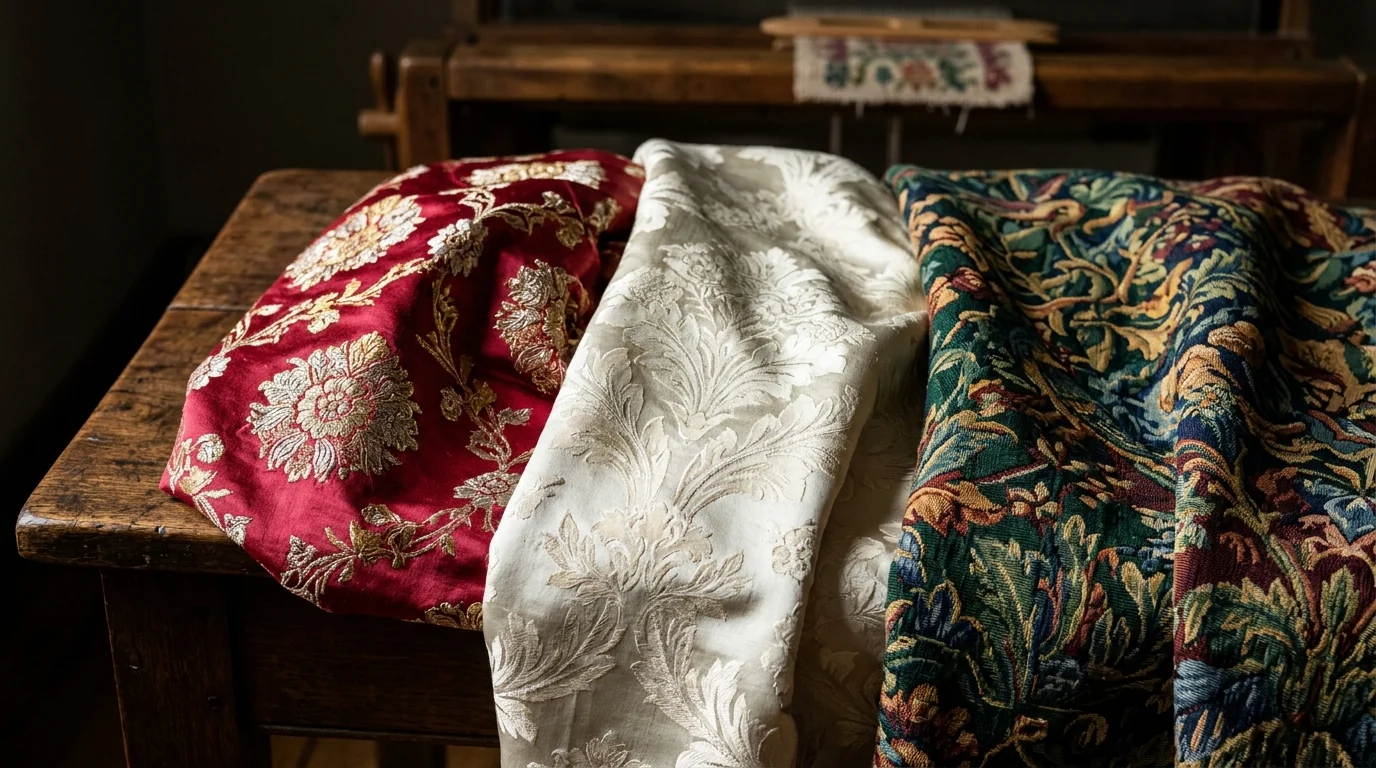

When comparing brocade vs damask, the decisive distinction lies in thread structure and reversibility: brocade uses supplemental decorative weft threads that float over a ground weave to create raised, multicolored, non-reversible relief, whereas damask weaves a single warp and weft system in alternating satin and sateen floats to produce a flat, reversible, monochromatic pattern. Jacquard is the overarching mechanical loom technology—invented in 1804—used today to weave both textiles.
Key Takeaways
- Reversibility Test: Flip the cloth over—damask shows a clean negative-image pattern on the reverse, while brocade reveals loose floating threads or clipped carries on the back.
- Color & Relief: Brocade excels at polychrome, embossed floral and gold-thread motifs; traditional damask relies on light reflection across matte and lustrous zones of one dye color.
- Jacquard’s Role: Every modern woven brocade and damask is a Jacquard fabric, though not every Jacquard weave (such as matelassé or tapestry) is a brocade or damask.
- Best Applications: Choose damask for reversible table linens and high-rub upholstery; reserve brocade for structured eveningwear, liturgical vestments, and low-friction drapery.
Table of Contents
1. Structural Anatomy: Brocade vs Damask Under a Magnifying Loupe
Shoppers and costume designers often confuse heavy figured silks because retail labels use historic weaving terms loosely. Examining the warp (lengthwise threads) and weft (crosswise threads) immediately resolves the brocade vs damask debate.
In true brocade—derived from Italian broccato, meaning “embossed cloth”—the weaver builds a sturdy plain, twill, or satin ground fabric first. An extra, non-structural supplementary weft shuttle then interlaces metallic gold, silver, or brightly dyed silk yarns solely where a pomegranate, dragon, or floral motif appears, floating across the underside until needed again.
Damask—named after the Silk Road trading hub of Damascus—uses no supplemental weft. Instead, it contrasts warp-faced satin (glossy) against weft-faced sateen or twill (matte). When gallery light strikes the cloth, the motif shimmers against a muted background even when the entire bolt is piece-dyed a single ivory, crimson, or emerald shade.
2. Master Comparison Chart: Brocade vs Damask vs Jacquard
Use this technical textile matrix to identify vintage garments, specify upholstery yardage, or evaluate museum costume pieces:
| Textile Property | Brocade | Damask | Jacquard (Umbrella Category) |
|---|---|---|---|
| Classification | Specific supplementary-weft weave | Specific reversible satin/sateen weave | Loom mechanism & all complex loom-figured cloth |
| Reversible? | No (back has floating or clipped weft yarns) | Yes (front and back invert matte/glossy faces) | Depends on sub-weave (damask yes; brocade/tapestry no) |
| Color Profile | Multicolored, often with gold/silver lurex or metallic wire | Traditionally monochromatic; occasionally two-tone | Single-color to multi-yarn pictorial weaves |
| Surface Texture | Raised, three-dimensional, embroidery-like relief | Smooth, flat, supple hand with light-play contrast | Ranges from flat damask to quilted matelassé |
| Abrasion Durability | Moderate (long surface floats can snag on jewelry) | High (tightly bound floats resist friction) | Varies by yarn density and float length |
| Classic End Uses | Structured gowns, corsetry, evening jackets, vestments | Fine table napery, dining chairs, drapery, bedding | Upholstery, tapestry, brocade, damask, knitwear |
3. Silk Road Origins: From Byzantine Courts to Italian Guilds
Long before mechanical automation, Chinese drawloom weavers during the Tang and Song dynasties mastered monochromatic silk damasks alongside polychrome jin brocades. Caravans carried these prized bolts westward through Persia and Damascus into Byzantine Constantinople, where imperial sumptuary laws restricted purple and gold-brocaded silks—closely tied to royal Tyrian purple dye monopolies—to the imperial household.
By the thirteenth and fourteenth centuries, Lucca, Venice, Florence, and Genoa established powerful silk guilds. Alongside medieval cut and voided silk velvet production, Italian drawlooms wove heavy gold-wrapped brocades for royal coronations across Europe, including the courtly attire of Queen Jadwiga.
Operating a Renaissance drawloom required two skilled artisans: a master weaver throwing shuttles at the reed and a “drawboy” perched atop the loom frame pulling ratusan harness cords in exact sequence to lift individual warp threads. Producing a single yard of heavy papal brocade could take weeks, as documented in textile archives at the Victoria and Albert Museum.
4. How Joseph Marie Jacquard’s 1804 Punched-Card Loom Changed Everything
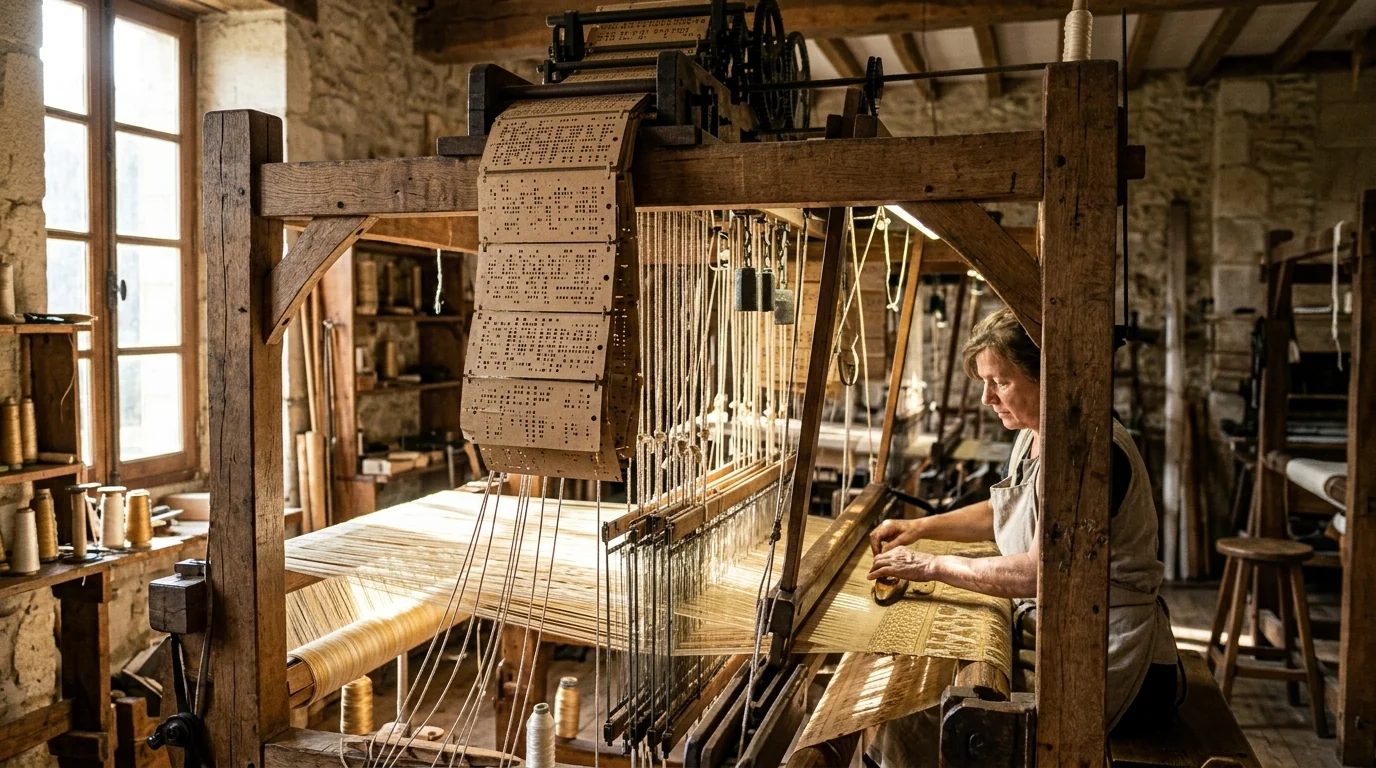
In 1804 in Lyon, French weaver and inventor Joseph Marie Jacquard perfected an overhead attachment controlled by continuous chains of perforated pasteboard cards. Each punched hole corresponded to a steel hook lifting a specific warp thread—a binary yes-or-no code that directly inspired Charles Babbage’s Analytical Engine and early computing.
Brocade vs Damask in the Nineteenth-Century Fashion Boom
Because punched cards replaced human drawboys and eliminated pattern errors, Lyon silk mills slashed weaving time twentyfold. Suddenly, intricate floral damasks and jewel-toned brocades became attainable for upper-middle-class households throughout nineteenth-century Victorian fashion and mid-century Civil War era evening dress.
Early twentieth-century couturiers pushed Jacquard looms even further. Visionaries such as Paul Poiret commissioned bold Orientalist metallic brocades from Lyon’s Maison Bianchini-Férier, while twenty-first-century innovators like Mary Katrantzou pair computerized CAD Jacquard weaving with trompe-l’œil digital textile engineering.
5. Five Field Tests to Identify Brocade vs Damask Instantly
Whether sourcing vintage yardage at an estate sale or choosing upholstery swatches, apply these five tactile checks preserved in conservation manuals from The Met’s Antonio Ratti Textile Center:
- Inspect the wrong side: Loose horizontal yarn bridges or trimmed fringe edges around motifs confirm brocade; a smooth, mirror-inverted pattern confirms damask.
- Close your eyes and run a fingertip across a flower: Raised, stepped thread ridges signal brocade; an almost flush satin-to-matte transition indicates damask.
- Tilt the swatch 45 degrees under a lamp: Damask patterns dramatically flip from dark to bright as warp and weft satin floats catch directional light.
- Count yarn colors at the selvedge: Multiple colored weft bobbins alongside metallic gilded threads point to brocade; one warp shade and one weft shade point to classic damask.
- Test drape stiffness: Brocade holds architectural bell skirts and structured bodices on its own, whereas linen or silk damask drapes fluidly across tables and tailored cushions.
6. Martindale Rub Counts, Sewing Needles & Archival Storage
Evaluating brocade vs damask for interior upholstery or couture tailoring comes down to abrasion engineering and seam allowance stability. Commercial upholstery mills test figured fabrics using the Wyzenbeek double-rub or Martindale abrasion cycles: tightly woven cotton-silk damask routinely exceeds 25,000 to 35,000 cycles suitable for everyday armchairs, whereas metallic-float brocade often rates between 9,000 and 15,000 cycles intended for decorative accent pillows, formal dining backs, or drapery.
In the sewing room, brocade frays aggressively the instant shears cut across unbound supplementary weft floats. Couture ateliers stabilize brocade pattern pieces with ultra-sheer silk organza underlining, cut generous three-quarter-inch seam allowances, bind raw edges in Hong Kong bias strips, and sew using fresh Microtex 70/10 or 80/12 sharp needles so metallic lurex or silk filaments never snag.
For long-term closet or museum storage in the brocade vs damask care routine, never hang heavy metallic brocade gowns on narrow wire or wood hangers where shoulder weight distorts bias grain. Instead, roll flat bolts or pad folded pleats with acid-free buffered tissue paper inside breathable unbleached cotton muslin bags, preventing tarnish on silver-wrapped threads and keeping reversible damask fibers supple for generations.
When commissioning custom drapery or eveningwear from historic European mills in Como, Lyon, or Kyoto, buyers comparing brocade vs damask should always request half-yard sample cuts before committing to full bolts. Comparing brocade vs damask under both natural north-facing daylight and warm evening sconces reveals how supplementary metallic floats catch specular highlights differently from flat satin-and-sateen damasks.
For any brocade vs damask drapery project, ask your workroom whether the selvedge carries a tight twill border, check whether silk-linen blends require preshrinking via cold-press steaming, and verify that any heavy brocade vs damask upholstery yardage includes an optional breathable knit backing. Mastering these practical brocade vs damask benchmarks ensures every bolt you specify honors centuries of Jacquard loom craftsmanship while delivering dependable brocade vs damask longevity across heirloom interiors and tailored wardrobes.
Frequently Asked Questions
Which is more expensive, brocade or damask?
Silk brocade is generally more expensive per yard than comparable silk or linen damask because supplementary polychrome and metallic weft shuttles slow loom speed and consume substantially more yarn weight.
Is brocade or damask better for dining chair upholstery?
Heavy upholstery-grade damask outperforms brocade on everyday dining chairs because its tightly bound satin-and-twill structure resists snagging on belt buckles, buttons, and pet claws far better than brocade’s raised surface floats.
Can brocade and damask fabrics be washed in water?
Pure cotton or linen table damask washes safely on a gentle cool cycle, whereas silk, rayon, viscose, and metallic brocade must never be machine-washed because differential yarn shrinkage puckers the raised motifs permanently.
Are printed fabrics with ornate scrollwork considered true damask?
No. Wallpaper and screen-printed cotton often market symmetrical acanthus scroll motifs as “damask print,” but authentic textile damask is strictly a loom-woven reversible structure rather than surface ink.