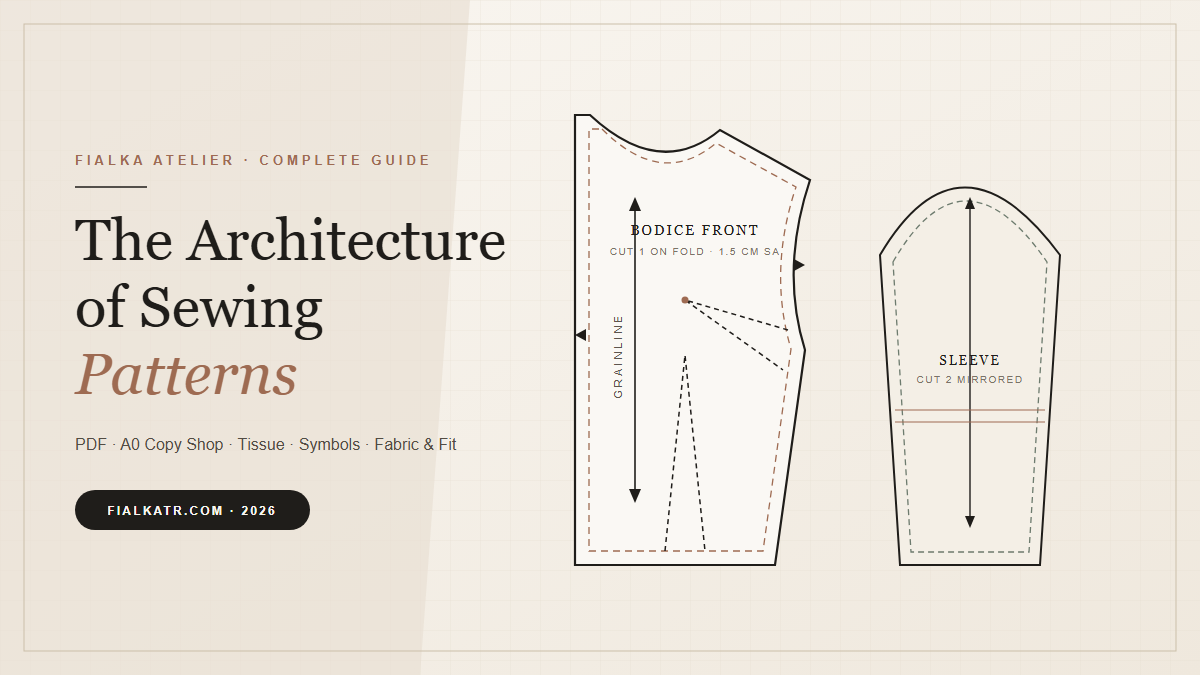

Every iconic garment in fashion history—from Christian Dior’s sculptural 1947 Bar Jacket to a minimalist Japanese linen shift dress—begins as geometry on flat paper. Sewing patterns are the quiet architecture behind the clothes we wear. In an era of disposable fast fashion and inconsistent retail sizing, learning to read, choose, and sew from patterns is the most direct path to a bespoke, slow-fashion wardrobe tailored to your exact proportions.
Key Takeaways (Quick Summary)
- What a sewing pattern is: A scaled two-dimensional architectural template—available in tissue paper, printable PDF (A4/US Letter or A0), or projector format—used to cut and assemble fabric into a three-dimensional garment.
- Best format for beginners: Layered PDF sewing patterns printed on A4/US Letter at home or on A0 sheets at a copy shop offer instant downloads, illustrated step-by-step instructions, and size-isolated printing.
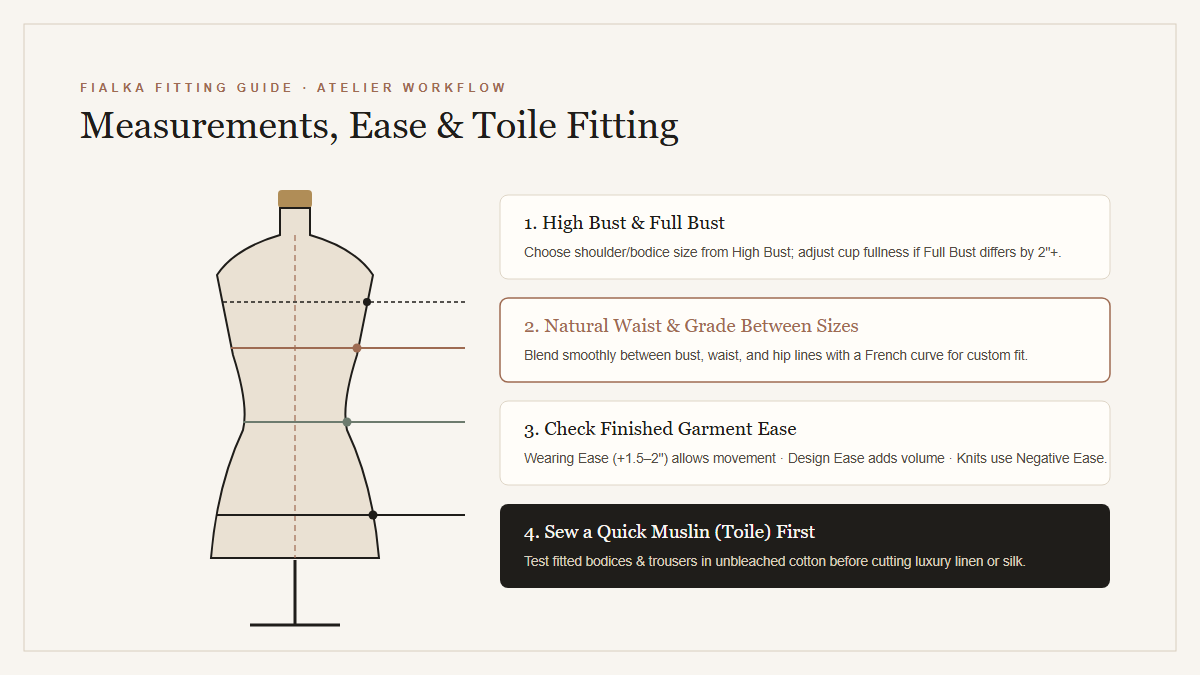
- The #1 sizing rule: Never choose your sewing pattern size based on ready-to-wear retail clothing sizes. Measure your high bust, full bust, waist, and hips, then compare against the designer’s finished garment measurements.
- Best starter fabrics: Mid-weight woven fabrics such as Belgian linen, cotton poplin, and washed cotton twill hold their shape under the presser foot and are far easier to sew accurately than slippery silk or stretchy jersey.
- Secret to couture-level fit: Sewing a quick test garment (called a muslin or toile) from inexpensive cotton before cutting into luxury fabric prevents costly fitting errors.
What Are Sewing Patterns and How Do They Work?
A sewing pattern is a precision blueprint that translates a three-dimensional garment into flat, cuttable pieces. Each piece includes seam allowances, alignment notches, grainline arrows, and shaping markings (such as darts or pleats) that instruct you how to lay the template onto fabric, cut it accurately, and stitch the sections together in a specific sequence.
In commercial fashion houses, master patternmakers draft blocks (also called slopers) by hand or in CAD software like Gerber and Clo3D, then grade them across a range of sizes. When you buy a home sewing pattern today, you are purchasing a professionally drafted, fit-tested version of that industrial blueprint—complete with a yardage chart, fabric recommendations, notions list, and illustrated assembly instructions.
Types of Sewing Patterns: Tissue Paper vs. PDF vs. A0 vs. Projector
Modern sewing patterns come in four primary formats: traditional printed tissue envelopes, home-printable A4/US Letter PDFs, large-format A0 copy-shop PDFs, and paperless projector files. Choosing the right format depends on how often you sew, your workspace, and whether you prefer immediate digital access over tactile paper envelopes.
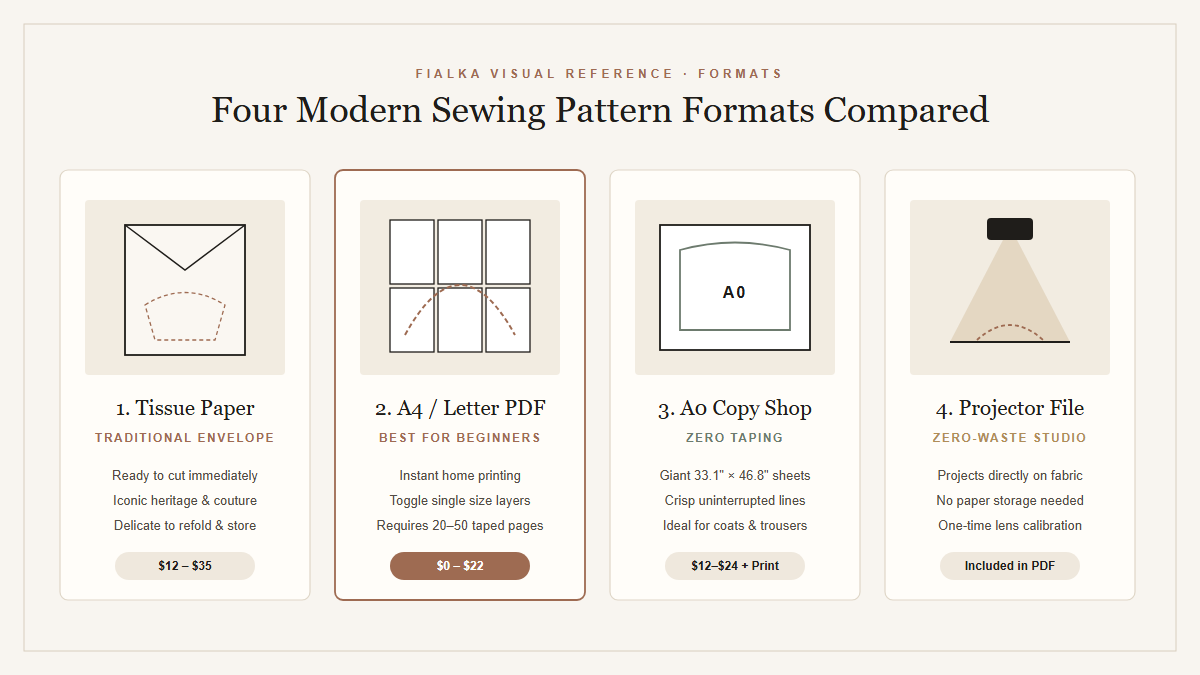
For decades, home dressmakers relied almost exclusively on the “Big Four” paper pattern companies (Vogue, Butterick, McCall’s, and Simplicity). Today, independent pattern studios have transformed the industry with layered PDF sewing patterns, allowing you to open a file in Adobe Acrobat Reader, toggle off every size except your own, and print cleanly without visual clutter.
| Pattern Format | Best For | Pros | Cons | Typical Cost |
|---|---|---|---|---|
| Printed Tissue Paper | Traditionalists & couture collectors | Ready to cut immediately; iconic vintage & Vogue Designer archives | Fragile paper; requires shipping; hard to refold neatly | $12 – $35 |
| Home-Printable PDF (A4 / US Letter) | Beginners & instant weekend projects | Instant download; size layers; reprint anytime | Requires taping 20–50 pages together accurately | $0 – $22 |
| A0 Copy-Shop PDF | Frequent sewists & tailored garments | Printed on giant 33.1″ × 46.8″ sheets; zero taping; crisp lines | Extra printing fee ($3–$8 per sheet) | $12 – $24 (+ print) |
| Projector Pattern File | High-volume sewists & zero-waste studios | Zero paper, zero taping, instant projection onto fabric | Requires mini-projector calibration ($80–$250) | Included with most indie PDFs |
How to Read Sewing Pattern Symbols Like a Patternmaker
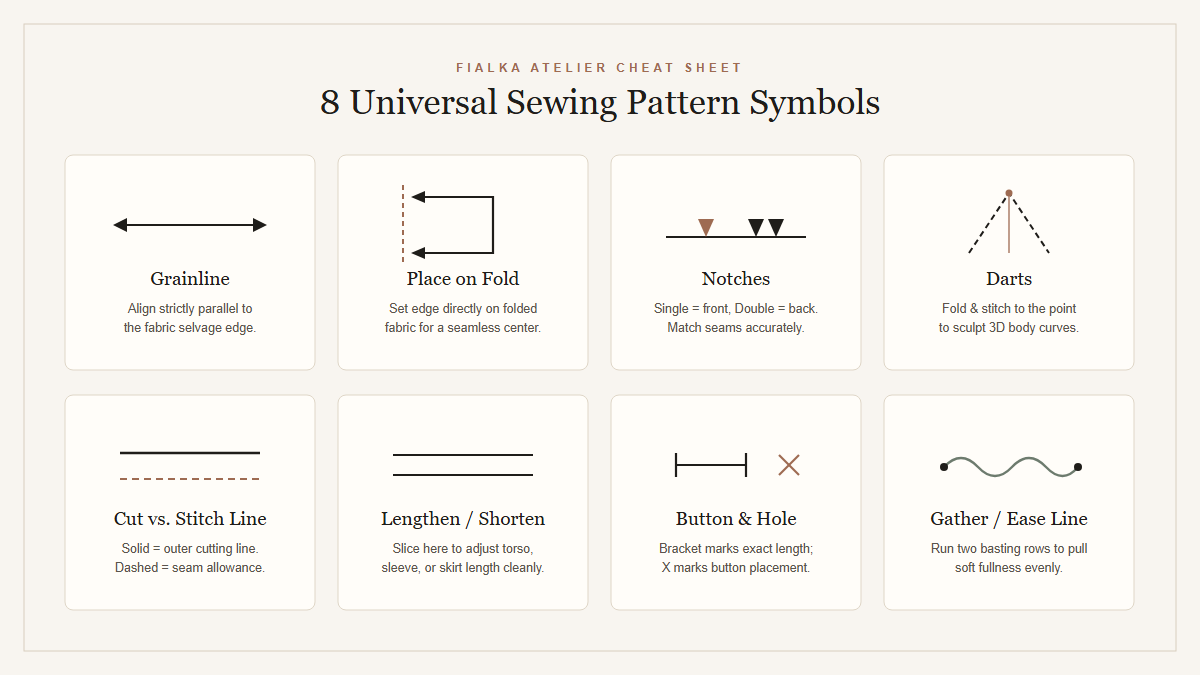
Every mark printed on a sewing pattern communicates a specific construction rule—ignoring a single grainline arrow or notch can cause a garment to twist on the body or fail to align at the seams. Learning the eight universal symbols below takes five minutes and unlocks virtually every sewing pattern published worldwide.
| Symbol | Visual Appearance | Exact Meaning | Why It Matters |
|---|---|---|---|
| Grainline | Long straight line with arrows at both ends (↔) | Place strictly parallel to fabric selvage | Prevents skirts and trousers from twisting around the legs |
| Place on Fold | Bracketed line with two arrows pointing to an edge | Align edge directly against folded fabric edge | Creates a symmetrical center front or back with no center seam |
| Notches | Small triangles or diamonds along cutting edge (▲) | Alignment markers (1 = front, 2 = back) | Ensures sleeves, curves, and waistbands match cleanly |
| Darts | Triangular wedge of broken lines and dots | Fold right-sides together and stitch to point | Shapes flat fabric around 3D body curves |
| Cutting Line | Solid or patterned outer line | Exact path for shears or rotary cutter | Always check whether seam allowance is included |
| Lengthen / Shorten Line | Two parallel horizontal lines | Zone to slice and add/remove length | Adjusts proportions without distorting armscyes or hems |
| Buttonhole & Button | Bracketed bar and small cross (✕) | Exact closure placement and length | Prevents gaping across the bust |
| Gather / Ease Line | Wavy line or two dots | Stitch two basting rows and pull bobbin threads | Controls fullness smoothly at sleeve caps and skirts |
How to Choose the Right Sewing Pattern Size
To choose the right sewing pattern size, ignore your store-bought clothing size completely and select your size based on three body measurements: high bust, full bust, natural waist, and full hip. Pattern sizing follows historical dressmaking blocks—a person who wears a US size 6 in ready-to-wear retail often measures as a size 10 or 12 on a Big Four pattern envelope.
Understanding Ease: Wearing, Design, and Negative Ease
- Wearing Ease: The minimum extra space needed to breathe, sit, and move comfortably in woven fabrics (typically 1.5–2 inches at the bust).
- Design Ease: Intentional extra volume that defines the silhouette—such as an oversized linen trench coat or boxy Japanese tunic.
- Negative Ease: Used in stretch knit patterns where the finished garment is intentionally smaller than your body so the fabric stretches snugly.
Fabric Pairing: Matching the Right Textile to Your Pattern
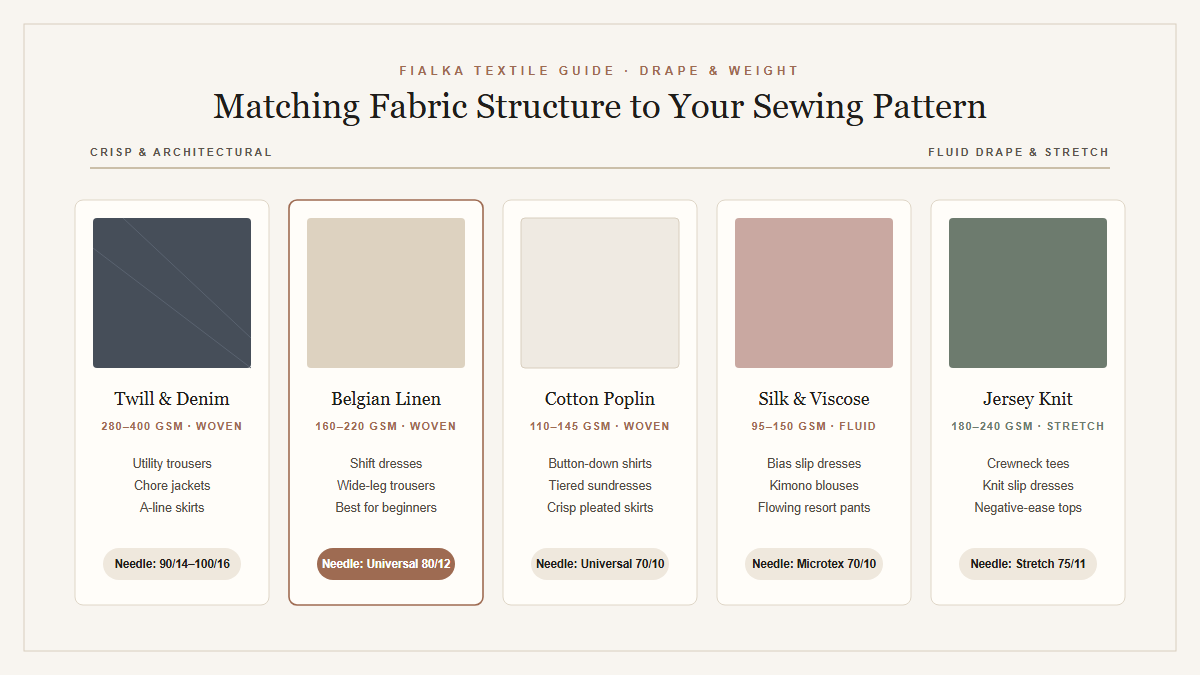
Even the most expertly drafted sewing pattern will fail if paired with the wrong fabric weight or drape. A crisp cotton poplin will stand away from the body in sculptural volume, whereas a fluid silk crepe de chine or viscose challis will skim and flow along the exact same pattern lines.
| Fabric Type | Category | Drape & Structure | Ideal Sewing Patterns | Recommended Needle |
|---|---|---|---|---|
| Belgian Linen (160–220 GSM) | Woven | Structured, softens with wear | Shift dresses, wide-leg trousers, chore jackets | Universal 80/12 |
| Cotton Poplin & Lawn | Woven | Crisp, lightweight, holds pleats | Button-down shirts, tiered sundresses, midi skirts | Universal 70/10 – 80/12 |
| Viscose / Tencel Twill | Woven | Fluid, silky drape | Bias-cut slip dresses, resort trousers | Microtex 70/10 |
| Heavy Twill & Raw Denim | Woven | Rigid, architectural | Utility trousers, structured totes, A-line skirts | Denim 90/14 – 100/16 |
| Cotton-Spandex & Merino Jersey | Knit | Stretchy, forgiving fit | Crewneck tees, knit dresses, loungewear | Ballpoint / Stretch 75/11 |
Step-by-Step: How to Use Your First PDF Sewing Pattern
Following a disciplined seven-step preparation workflow—from test-square calibration to sewing a quick muslin—eliminates 95% of beginner cutting and fitting errors.
- Download and Inspect Layers: Open your PDF pattern in Adobe Acrobat Reader and toggle off every size layer except your selected size.
- Calibrate and Print: Print only the test square page first at 100% Actual Size and verify its dimensions with a ruler.
- Assemble or Trace: Trim margins, align corner markers, tape sheets together, or trace your size onto Swedish tracing paper.
- Pre-Wash and Press Your Fabric: Wash, dry, and steam-press natural fibers before cutting to eliminate shrinkage.
- Lay Out on Grain: Align every grainline arrow strictly parallel to the fabric selvage.
- Cut and Transfer Markings: Cut with sharp dressmaking shears, clip notches, and mark darts with tailor’s chalk.
- Sew a Quick Muslin (Toile): Test-fit structured bodices or trousers in inexpensive cotton muslin before cutting luxury fabric.
Best Indie & Heritage Sewing Pattern Brands (2026)
| Pattern Studio | Aesthetic & Specialty | Format & Sizing | Best Entry-Level Pattern |
|---|---|---|---|
| Merchant & Mills | British utilitarian minimalism & linen workwear | Printed & PDF (UK 6–28) | The Camber Set |
| Closet Core Patterns | Modern wardrobe staples & tailored trousers | PDF & Print (0–32) | Cielo Top & Dress |
| Friday Pattern Company | Relaxed silhouettes with video sewalongs | PDF & Print (XS–7X) | Ilford Jacket |
| Vikisews | Runway-inspired European tailoring | Height-graded PDFs | Nola Dress |
| Matchy Matchy Sewing Club | Playful, beginner-friendly slow fashion | PDF (XXS–6XL) | Horizon Day Dress |
| Vogue Patterns | Architectural couture & vintage reissues | Tissue & select PDFs | Very Easy Vogue |
Frequently Asked Questions About Sewing Patterns
What are the easiest sewing patterns for absolute beginners?
The easiest sewing patterns for beginners are woven pull-on garments with minimal pieces and no zippers or buttonholes—such as an A-line shift dress, an elastic-waist linen skirt, a boxy kimono-sleeve top, or a structured canvas tote bag.
Are seam allowances included in sewing patterns?
Most American, British, and Australian indie sewing patterns include seam allowances (typically 5/8 inch or 3/8 inch). Several European pattern magazines and Japanese pattern books exclude seam allowances, so always verify in the instruction booklet before cutting.
How do I print a PDF sewing pattern at home without messing up the scale?
Open the PDF in Adobe Acrobat Reader, select Actual Size or 100% scale, disable Fit to Page, and print only the test-square page first to verify the exact measurement with a rigid ruler before printing the remaining pages.
What is the difference between A4/US Letter and A0 sewing patterns?
A4 and US Letter PDFs tile the pattern across 20 to 60 home-printable pages that you tape together. A0 PDFs fit the full pattern on 1 to 3 large-format copy-shop sheets (33.1″ × 46.8″) with zero taping required.
Can I reuse a sewing pattern multiple times?
Yes. Trace your selected size onto translucent Swedish tracing paper, kraft paper, or medical exam paper instead of cutting directly into the original master sheet.
How do I know how much fabric to buy for a sewing pattern?
Check the pattern’s fabric requirements chart using your pattern size and fabric bolt width (usually 45″ or 60″), and add 1/4 to 1/2 yard extra for stripes, plaids, or napped fabrics.
Why does my handmade garment fit differently than the model photo?
Fit differences usually stem from fabric drape, height proportion (most patterns are drafted for a 5’5″–5’6″ B-cup block), or overlooking finished garment measurements for ease.
Where can I find free, high-quality sewing patterns online?
Top sources for professionally drafted free sewing patterns include Peppermint Magazine, Fabrics-Store.com, Mood Fabrics Sewciety, and starter patterns from Closet Core and Friday Pattern Company.